




by Shari McMinn
For you formed my inward parts; you knitted me together in my mother’s womb. I praise you, for I am fearfully and wonderfully made. Wonderful are your works; my soul knows it very well. My frame was not hidden from you, when I was being made in secret, intricately woven in the depths of the earth (Psalm 139:13-15 ESV).
Created in God’s Image
When you observe your child, do you see that he or she is “wonderfully” made? Or do you only see their current shortcoming? It is hard, sometimes, to see the goodness in God’s creation in our children when their obstinate behavior, lack of motivation toward chores and schoolwork, and overall personality are things we do not view favorably. So, I encourage you to see your child as God’s “fearfully” made creation.
God created your son or daughter for His glory and purposes. God set your child in your family through birth, adoption, or other circumstances over which He has full control. He is working within each child and each parent at all times, for the good of His Kingdom. In the midst of the daily battles of life, be sure to view your child through the perfect lens of Almighty God and His Truth as found in His Word. I firmly believe it will change you, your relationship with your child, and your homeschool journey — for good!
In thinking about how each of us is uniquely made in God’s image, what does His Word say about the creation of mankind? So God created man in His own image, in the image of God He created him; male and female He created them (Genesis 1:27). And God saw everything that He had made, and behold, it was very good (Genesis 1:30). So, I want to remind you that God created you and your child in His image, God called His Creation good, therefore, His Creation of you and your child is good! Our sin nature often gets in the way of parenting and homeschooling. Yet we have hope as we look to Christ for help!
Unique Learners 2026 Poll Results
Now, I am excited to share with you the results of our Unique Learners Poll, conducted this past spring. Homeschool parents and professionals who work with children who have learning labels — from physical disabilities, to learning struggles, to emotional trauma, to highly gifted intellect — participated in this “non-scientific” poll to help us further identify the needs of our unique learner homeschool constituency.
Between March 15 and April 15, 2026, 79 members of our Unique Learner homeschool community highlighted their top priorities by reporting learning disabilities they experienced in the homeschool community. Because participants could select up to five options, we recorded 338 total responses.
The poll confirmed a large number of respondents coping with multiple learning disabilities. More than two-thirds of respondents are dealing with ADHD (76%) and Dyslexia (70%), and more than 50 percent reported dealing with Executive Function Disorder (53%). Close to half are also dealing with Dysgraphia (42%) and Sensory Processing Disorder (42%).
Below, we ranked the 11 self-reported needs from greatest to least.
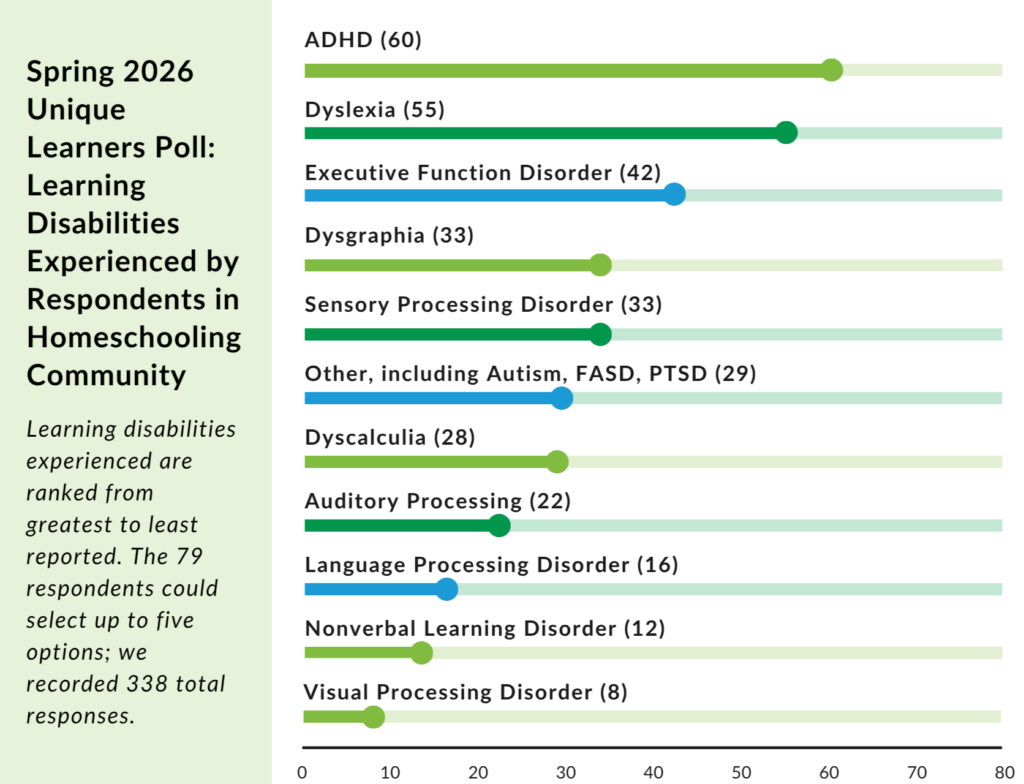
Percent of respondents who reported this learning disability:
- ADHD (60 responses): 76%
- Dyslexia (55 responses): 70%
- Executive Function Disorder (42 responses): 53%
- Dysgraphia (33 responses): 42%
- Sensory Processing Disorder (33 responses): 42%
- Other, including Autism, FASD, PTSD (29 responses): 37%
- Dyscalculia (28 responses): 35%
- Auditory Processing (22 responses): 28%
- Language Processing Disorder (16 responses): 20%
- Nonverbal Learning Disorder (12 responses): 15%
- Visual Processing Disorder (8 responses): 10%
In response to this poll, CHEC will continue to provide relevant resources in these areas of need for homeschooling families with unique learners. Be sure to sign up for our CHEC Blog weekly emails, subscribe to our Colorado Homeschool Podcast, and our FREE CHEC Homeschool Update print magazine, mailed to your home, to access encouragement and practical strategies for home educating your wonderfully made student(s).
If you did not participate this spring in our Unique Learners Poll, you can do so now at that link. We will offer this poll as an ongoing assessment of Unique Learner needs in the homeschool community in Colorado and beyond.
Dive Deeper: Unique Learners Resources
- If you believe your unique learner — and you as the homeschool teaching parent — would benefit from a professional evaluation of your child’s struggles and/or tutoring, please go to this CHEC Professional Tutors, Evaluators, and Testers webpages to find support services in your area. Each professional and their associated programs and/or services have been well-vetted by CHEC.
- Find more support for you and your unique learner on CHEC’s Unique Learners webpages.
- The CHEC.org website and all of our CHEC Recommended Resources webpages were fully updated this spring. Please take time to thoroughly review and study all the recommendations available to Unique Learner families through CHEC!
My next Unique Learner blog, “Planning for the Upcoming School Year,” will be posted on August 12, 2026 (the second Wednesday).
Shari McMinn, your trusted homeschooling friend
P.S. If you have a topic I should write about, please email me with your suggestion(s). This blog is for you!
This is great! Thank you! Are there resources for Homeschool PARENTS who are unique learners?
Kelly, that is a great question!
I will search through our currently listed resources and see what we might have that would speak to this question. Thanks for reading the blog and submitting a comment!
Kelly, that is a great question!
I will search through our currently listed resources and see what we might have that would speak to this question. Thanks for reading the blog and submitting a comment!
Kelly, I had some responses from other unique learner advisors I network with and here are their suggestions to your query:
1. This can be challenging as there are some parents with special needs who definitely should not homeschool their own children. I do work with some parents with learning struggles themselves, and have do testing for them as well. I have some parents doing The Listening Program (TLP) (www.advancedbrain.com ), and I am providing the support and coaching that extends into executive function, planning, relaxation, sleep, and more.
If the parent has major issues where they are really bad with math, then they need to hire a math tutor/teach to teach the child. If the issue is reading comprehension, then the parent needs to get the student in with a reading tutor or teacher. Some states have co-ops that run as schools where other parents do the teaching or they hire a person to teach. That too becomes a challenge as the co-op classroom is not a special ed class and the teacher(s) may not have experience to deal with the child’s challenge.
2. As a parent with LD (dyscalculia) myself, homeschooling for our family would not have been possible alone.
I would recommend she find support in her community, outsource classes (through co-ops, private schools, micro-school, or online), and join SpedHomeschool;
https://www.spedhomeschool.com/account/login?ReturnUrl=%2Fgroups
If the parent has difficulty with executive functions (such as organization, planning, scheduling, time management), then working with a coach or mentor and a support group could be beneficial. Vicki Bentley, Homeschooling with Confidence, is highly recommended.
Additionally, private counselors or psychologists can help families by teaching coping strategies to assist them to work around executive functioning, anxiety, etc. or various challenges that impact managing “life”.
The parent can teach the subjects that are strength areas, but outsource via Outschool, BJU Press, digital/online learning, etc. other core subjects that he/she can not handle due to his/her own processing difficulties. For instance, personally, I paid a tutor and also found math classes offered at co-ops and private schools for my daughter. Another mom and I swapped teaching…I taught the high-school literature and writing and she taught the science and math class.
I hope these ideas are helpful.
A couple of recommended national organizations/web- sites are:
CHADD
Understood.org
Decoding Dyslexia
3. I don’t know of any websites, unless there is something on SPED Homeschool. I would look at local support groups or co-ops to see if someone or some group is able to help. In VA, we have groups like Homeschool Plus that offer classes a couple days a week – something like that might be helpful if she has difficulty in a specific area (e.g., math). I will keep a lookout for anything that I might come across that could help.
Kelly, I hope these point you in the right direction!