


by Julianna Duerksen
To get you started on a Thanksgiving Unit Study, here’s some background about the history of Thanksgiving. Try reading it out loud, then, check out the activities below!
“They found the Lord to be with them in all their ways, and to bless their outgoings and incomings, for which let his holy name have the praise forever, to all posterity.”[1] –William Bradford, Governor of Plymouth
That’s how William Bradford summed up the early years at Plymouth Plantation. Ever since the Separatists had stepped foot on Cape Cod, they had seen God’s provision time and time again.
That’s not to say those first few years after the landing of the Mayflower in 1620 were easy. That first winter, half of the company died of disease, leaving only about 50 settlers. Food was scarce and often ran out in the long Massachusetts winters.
But just when help was needed most, God would send deliverance. After the first winter, an Indian named Samoset from a surrounding tribe presented himself to the settlement. To their surprise, he spoke English and explained he had interacted with various English explorers who had come to the area. Samoset introduced the Separatists to a friend of his, Squanto, who had spent time in England.
Squanto became a “special instrument sent from God for their good beyond their expectation.”[2] Though the surrounding Indian tribes had slaughtered nearly all the other Englishmen who had dared step foot in the area, Squanto negotiated peace between the Separatist colony and the Indian Chief Massasoit. He stayed with the Separatists and acted as their interpreter, taught them how to plant corn, and lent his hand in their struggle for survival.
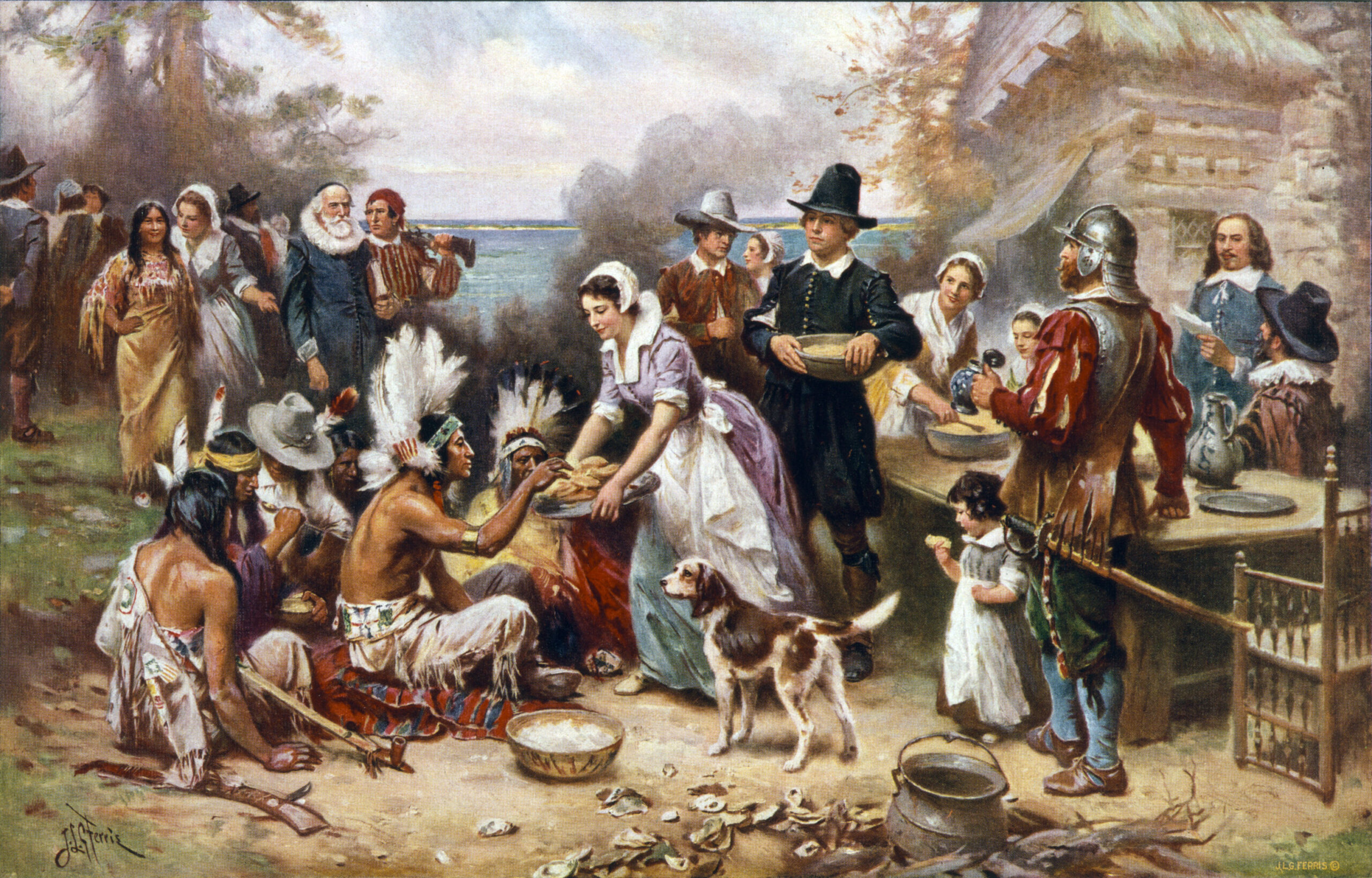
 By that fall, God had blessed their work abundantly. They had stored up a rich harvest of fish and wild turkeys, venison, and corn. As the harvest ended, they celebrated the first Thanksgiving along with their Indian neighbors. For three days, they feasted, celebrated — including practicing militia demonstrations — and rejoiced in all God had done.
Winters continued to be difficult as supplies still ran low, and often other ships would bring more settlers but no more provisions to feed them. But as they trusted God, they saw Him faithfully provide.
One summer, a drought began to dry up the land. For three months, the scorching heat threatened to completely abolish their crops. They proclaimed a day of fasting and prayer to entreat God for His mercy. As they began to pray, the sun rose to a blistering heat with not a cloud in the sky. But that same afternoon, to the Indians’ astonishment, clouds gathered and the rain began to pour down in perfect showers, with no sign of a wind that might have brought it in. The rain continued throughout the rest of the summer, and they gathered an abundant harvest. Once again, they set apart a day for thanksgiving.
Since then, America has called days of thanksgiving for many acts of Providence in our history. Washington declared December 18, 1777, the first national Thanksgiving, remembering the victory of Saratoga. Finally, during the War between the States, Abraham Lincoln instituted the federal holiday of Thanksgiving as a day of praise for God’s blessing and prayer for the ongoing war.[3]
Thanksgiving Unit Study Resources
Consider checking out the following books/audios at your library or through interlibrary loan:
- If You Were at the First Thanksgiving by Anna Kamma (Elementary): All about the Pilgrim life with fun illustrations
- Squanto’s Journey: The Story of the First Thanksgiving by Joseph Bruchac (Elementary)
- Squanto: A Thanksgiving Drama, Focus on the Family
- Squanto and the Miracle of Thanksgiving by Eric Metaxas (Elementary)
- The Landing of the Pilgrims by James Daugherty: A children’s chapter book by a Newberry Award-winning author
- Letter by Edward Winslow (High School)
Thanksgiving Unit Study Activities
- Take a Virtual Tour of Plymouth Plantation [Note: The Plimoth Museum isn’t a Christian organization, so please use discernment as to their historical perspective.]
- Eight Pilgrim Crafts for Thanksgiving
Dive Deeper
- Read “Thankful in the Good, the Bad, and Even the Ugly,” by Shari McMinn, on the CHEC Blog.
- Listen to “Homeschool Styles Unpacked: Real Moms Share Their Journey” on the Colorado Homeschool Podcast.
- Browse additional resources for homeschooling during the holidays on the CHEC Blog.
[1] William Bradford, History of Plymouth Plantation (Boston, 1856), 105.
[3] Excerpted from Julianna Dotten, Colorado Civics: A Curriculum for Home Educating Families (2018, Parker), 161–62.
[4] Painting by Jean Leon Gerome Ferris (1863–1930)
 About the Author: Julianna Duerksen
0 Comments