





by Shari McMinn
A few months ago, I enjoyed a lengthy discussion with a trusted friend who is a “retired” homeschool mom. The Lord has laid it on her heart to start a low-cost, family-friendly homeschool group at her church for homeschool enrichment. She asked me for my advice on starting one and how to keep it going. She sees the need for it, and others in her community are not stepping up to provide this valuable form of engagement.
This summer, many homeschool families have been caught in the crossfire between wanting to home educate their children and having previously used public school “homeschool” programs to “enrich” their students’ home education experience. Now that those programs are not within their reach unless they comply with new Colorado regulations, how can they affordably provide art, music, sports, and other “enrichment” opportunities for their home-educated students?
The Big Picture of Cooperative Associations
If you are a history buff and one who appreciates the civics lessons of our nation’s founding, you may be familiar with the book Democracy in America by Alexis de Tocqueville. My takeaway from that French political philosopher’s view of the American “middle” was that each community he toured had impressive “associations” for solving the many issues which pioneers faced. Those families, especially settlers in the Ohio River Valley, took matters into their own hands instead of waiting for the fledgling US federal government to solve them with new legislation and taxpayer funding.
Led by volunteers, these associations cleared forests, built bridges, created transportation waterways and highways, established churches, and installed magistrates to keep order and peace. All this while these often impoverished families were extremely busy from dawn to dusk building their homes, keeping up with endless housework done by hand, farming their land, and raising their children under God’s sovereignty to become a valuable “working class” in their new nation.
The Value of Local Homeschool Groups
With that explanation in mind, my suggestion to Colorado homeschool families is to start their own “cooperative associations” to meet the enrichment needs of their collective students. My own home-educated children benefited greatly from our memberships in volunteer-led and operated local homeschool groups.
 Other parents and I helped to create and lead those groups of disparate families, from different backgrounds, different faith traditions, and even some with differing political views. Our “associations” thrived because we had the common thread in our lives of wanting to homeschool our children K-12 free of government control, without reliance on taxpayer funding. Parents pitched in to teach hands-on activities and frugally provided needed supplies. Our field trips were often on “free” days or to local businesses without admission fees.
You may be thinking, “But I am not a leader; how could I form such a group to benefit my child(ren)?” When I began to lead, first one group then another, I did not have any specific leadership qualifications or formal training. I simply had a desire to provide field trips and hands-on group classes for my homeschooled students. My children had wide-ranging interests, so my late husband and I set out to provide what they wanted. While doing so, we walked alongside other families who had similar desires for group learning and “socialization,” but who felt inadequate to the task on their own.
Colorado Homeschoolers Facing Policy Changes
Why are parent-led homeschool groups an important consideration for homeschoolers, specifically during this coming academic year? During the 2026 Colorado legislative session, the School Finance Act (SB26-023) was passed, changing the requirements for homeschoolers to use government-funded, part-time enrichment programs. Now, families must file an annual Notice of Intent with a school district and follow the requirements of the Home-Based Education Law to enroll in these programs.
Though these new regulations did not change the homeschool statutes that outline three options for legally homeschooling in Colorado, there are now restrictions on the use of taxpayer funding for public school “homeschool enrichment” programs. This recent news article explains the situation in-depth.
Starting and Maintaining a Local Homeschool Group
The question this blog seeks to answer is: How could you, as just one homeschool parent who may feel ill-equipped to undertake starting a local homeschool group, begin to establish one? Here is the advice I offered my friend while we enjoyed that morning’s coffee:
1. Identify your “why.”
Why do you need a homeschool group and, therefore, want to form one? Is it for socialization, friends for your kids and yourself, parenting guidance and support, teaching by others for subjects you are weak in, enrichment activities like hands-on science, or monthly field trips? If, like me, your “why” is all of those and more, then I recommend you start a group organized by you and a couple of other like-minded parents in your community or church. You can then invite other families to join you 2-3 times a month as the perfect answer to your why!
2. Determine where you will meet.
 I suggest your own local church is the place to start, or at least one in your area that has the space for approximately 6-15 families (15-50 children). You will likely meet most of the time in a large group, maybe splitting into smaller groups depending on the activity. A church with a gymnasium or “fellowship hall” would provide space for indoor recreation, hands-on learning, and even lunch if families wanted to bring “brown bags” for social engagement after the morning meeting.
Churches that support the idea of a Christian education, particularly through homeschooling, ought to graciously provide space for your group. Negotiate a low-cost “rent” for your use of the church that covers the utilities and paper goods your group consumes. Although I am no longer homeschooling, the church I currently attend offers a similar use situation for a homeschool group that meets every Monday in our spacious facility, using a few classrooms and restrooms.
3. Decide who will help lead group meetings.
Whether you meet once/month or more, you will want to to share the responsibility of running your group meetings and leading activities. This could be you as a leader or other parents who are comfortable gaining everyone’s attention to start by opening with prayer, sharing a brief Bible devotion appropriate for all ages, maybe announcing marriage anniversaries and birthdays being celebrated in the group that month, then reviewing what the morning will entail. Parents or other guest professionals then lead the enrichment activity. After the activity is concluded, someone will need to gather everyone up to close, pray again, and then announce reminders for future get-togethers.
(BTW, I recommend “morning only” activity meetings or scheduled field trips so that families with young children can get home on time for naps or fall asleep on the car ride home.)
4. Enlist volunteers for teaching your enrichment activities.
In one group I led, we had a mom who was very athletic. She started each month’s activity morning with fun, energy-burning team sports in the gym. During months when she was not available, we asked the oldest one or two teens to lead some team-building games for all ages. For the hour-long learning portion of the morning, parents were asked to sign up to teach a hands-on class within their skill set once during the nine months of the year our group met. Through the years, we had member dads and moms who were skilled, or at least interested in, teaching widely varied “activity classes.”
If you live in a small town or close-knit urban community that is family-friendly, most local business owners or professionals are willing to donate their time one morning once a year, so do not overlook asking local experts such as a banker, church elder/deacon, county extension agent, first responder, mechanic, pastor, retail store owner/manager, scientist, or veterinarian to come and speak about what they do professionally or vocationally. Encourage them to bring “hands-on” interactive props or projects to do with the students and not rely solely on lecture-type slide shows that tend to bore younger kids.
5. Plan a monthly field trip to local sites.
 Opportunities for local field trips abound, including such places as archeological ruins, geographic features, historic markers, industrial plants, museums, zoos or aquariums, and outdoor recreational spots for hiking or fishing. Again, one parent should volunteer to be in charge of organizing at least one field trip annually, with oversight by the leadership team. Try to plan field trips on “free days” at paid venues, or free locations, so all your families can participate in the experience with minimal expense.
6. Share any additional group responsibilities.
Consider how you will handle dues, communication, facility interaction, and membership forms. Will someone be the “treasurer” who can open a no/low cost checking account for deposits and withdrawals? Can one parent be in charge of publicity (email newsletters, social media posts, etc.), and another parent volunteer to be the liaison for the facility’s use? How about a membership coordinator to handle annual sign-ups online or on paper? Split up the work to prevent burnout.
7. Consider other types of homeschool support you can provide.
 One group I led had an additional monthly meeting wherein the moms would gather for a “night out” at one of their homes. Simple refreshments were served, and the atmosphere was casual, intended to encourage one another, pray for each other, and offer tangible help if one family needed assistance during childbirth, the death of a loved one, or just the trials and tribulations that the Lord allows in our lives.
The dads in that group met at least once a year for a group-wide BBQ or car show-type activity to edify each other as homeschool dads. For many years, that group also ended the homeschool year with a super fun recreational track and field meet. We invited other area homeschool groups to participate, getting almost 100 students some years, PK-12th grades!
Accountability and Affordability for Homeschool Families
There seems to be a lot of negative news in the mainstream press concerning how homeschoolers operate “under the government oversight radar,” and thus, children are at risk of abuse; therefore, more government regulation is required. This is a fallacy that has been proven false time and again by research statistics and recently detailed in an article by attorney Kevin Boden, “Homeschooling Is Not to Blame for Abuse and Neglect,” just published in the Home School Legal Defense Association’s Court Report magazine (Vol. 42, Issue 2, 2026). To help prevent such false allegations against your family, I suggest that you and other homeschool families meet regularly in local associations for support and accountability.
Families who are joined together to support each other through the ups and downs of life are then accountable to one another. They have caring oversight into each other’s lives, which is always better than mandated, uncaring government oversight. When we share our lives and come alongside each other as fellow Christians through homeschool associations, we can pray for each other’s needs, confess our sins, and seek the Lord for solutions to our problems, whether educational, financial, physical, et. al.
As James 5:16 states:
Therefore, confess your sins to one another and pray for one another, that you may be healed. The prayer of a righteous person has great power as it is working. (ESV)
In a world of public-school-based homeschool enrichment programs, which now have a high cost to families who must pay out-of-pocket if they are enrolled in an “umbrella school,” establishing a local, family-friendly homeschool cooperative group has many benefits. This type of group can provide low-cost, low-fuss, engaging, meaningful learning activities with the bonus of families getting to know one another better in our often isolated culture.
Parents take turns volunteering to teach, and they stay with their children instead of dropping them off. Students of all ages participate together, becoming friends who look forward to shared playing and learning. The host church becomes a hub for the Christian life in addition to Sunday worship services. Christ is focused on, the Holy Spirit is present, and families look to their Creator as Father. This restores the heart of homeschooling by making it Christ-centered, parent-directed, and free from government control.
Is the Effort of Starting a Homeschool Group Worth It?
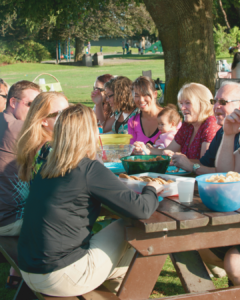 I believe in the short- and long-term benefits of parent-led, family-friendly, low-cost homeschool groups! These “old-fashioned” types of homeschool groups were crucial in the early days of the home-education movement (think 1980s), and are needed now more than ever in the 2020s!
The two groups my family belonged to over the span of 28 years helped me successfully homeschool nine of my 11 children through high school graduation. Plus, we remain friends today with many of the members of those groups, working together at the Rocky Mountain Homeschool Conference or sharing our lives through the wonder of social media. It is thrilling for me to see what those homeschooled students are now doing as they flourish as adults.
Certainly, starting a homeschool group takes a desire and some organization on your part, but the rewards will bring you and your family joy as you bring glory to God. For more information on starting and maintaining a homeschool cooperative support group, I suggest you purchase CHEC’s The Homeschool Guidebook for Colorado and study Chapter 9, Part II, “Leading or Starting a Homeschool Group.” This will give you additional ideas and practical support (including form templates) for planning and structuring your cooperative group so that other families want to join and fully participate long-term.
The Home School Legal Defense Association has one of its many attorneys available to serve homeschool groups. For queries and services you might need to establish your new group, connect with Darren Jones, Esquire, through their HSLDA Group Services webpage.
Why Not Start With a Year-Long Unit Study Already Planned Out?
In closing, I suggest you consider this excellent CHEC resource, US & Colorado Civics: K-12 Civics + History, as a nine-month-long unit study for your new homeschool group. Your families will learn the importance of voting in the upcoming November election, the founding history of the United States and Colorado, and interesting biographical accounts of historical figures from all walks of life. This standalone resource includes numerous hands-on learning activities and even field trip suggestions!
Surely, that makes planning and launching your new homeschool group even easier than you thought, right?

0 Comments