





by Shari McMinn
Homeschool dads and moms, do you ever say things like this to your unique learners? “You are so lazy!” “You can’t do your schoolwork without me sitting right there to force you!” “You never complete your assignments!”
Do you think things like: “My kids HATE school! They say it is so boring!” “I want to teach my kids, but they resist learning.” “I hate being a homeschool teacher; I’d rather be working or having fun with my own friends.” “When will the drudgery end?”
These are common accusations and thoughts for many homeschooling families, but they can be more pronounced and ongoing when struggling learners are in the family dynamic. As parents, it is important for us to realize what makes our kids “tick,” what motivates them, what distracts them, what loses their interest, and what piques their curiosity. These are things a good teacher seeks to understand, and it takes concerted effort through time, attention, research, and application.
Yes, it can be extra work! But the front-loading of work now will pay out later when your child becomes engaged with learning, begins to ‘own’ his or her home education, and starts to flourish in your family’s homeschool environment.
When I faced days filled with negative attitudes resulting in statements like those above, including my own unspoken thoughts, I learned to change things up to re-engage my kids and myself in our learning journey. I had to study God’s Word for guidance and inspiration.
Go to the ant, O sluggard; consider her ways, and be wise. Without having any chief, officer, or ruler, she prepares her bread in summer and gathers her food in harvest. How long will you lie there, O sluggard? When will you arise from your sleep? A little sleep, a little slumber, a little folding of the hands to rest, and poverty will come upon you like a robber, and want like an armed man (Proverbs 6:6-11 ESV).
 I didn’t want my kids to be sluggards or see me being one! So, we stopped the book work and headed outside on sunny days or into our “art and science barn” if the weather was inclement. I took the initiative to start doing something with my hands, and my kids quickly joined in. Whether it was clearing out wind-blown debris in our large corral to then play baseball, straightening up a messy shop area so we could start a team-building project, or walking along our half-mile driveway to our mailbox singing Broadway musical tunes, the energizing activity performed as a family gave us a sense of camaraderie as we worked together in our homeschooling lifestyle. The boredom, complaining, and negative thoughts vanished into lively conversation and memorable antics.
Preventing Boredom During Schoolwork

I remember being bored to death in public school when, class after class, we opened our textbooks while the teacher lectured. In the classes I enjoyed learning — Art, Geometry, History, Music, and Science — the best teachers had us doing something. Whether it was reading aloud, drawing out the lesson, creating a scale model replication, developing a skit, or performing a speech, the learning stuck when we did something more than sit and read silently.
I was a kinesthetic, verbal, and visual learner, as was my husband and most of my kids. A couple of my children were auditory learners, some interpersonal, and some intrapersonal. With so many different learning styles, I tried to include each style every day through our school lessons and life experiences. This took the boredom out of our daily routine by seasoning and spicing the otherwise mundane chores and schoolwork with enjoyable activities and interactive dialogue.
Engaging Students in Life Opportunities
Chores are drudgery unless you put on music and do them together! Or promise a simple treat like ice cream once they are completed. Cleaning the bathroom, weeding the garden, folding laundry, and scooping up animal waste are no fun to do alone! But if you have a buddy, a parent, or a whole family working hard to accomplish a task, it goes faster and can actually be fun.
While you work as a team to get things ship-shape, remember you are building character and memories. Share stories of your childhood, discuss dream vacations, share your favorite early marriage memories, and invite your children to critique and share their own. Sing! Whether it be country western, gospel, or “Fiddler on the Roof” classics, singing builds companionship and keeps the tedium at bay.
Later, when the chores are finished, do something enjoyable together as a reward. Not with financial expense per se, but the expense of time. Go for a bike ride, play a rowdy board game, cook a gourmet meal together, and dress up to eat it. These are life opportunities that the average American family does not share, but kids and parents alike end up cherishing over time.
Leading the Way with Fun Learning
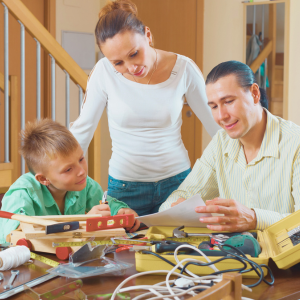 Is there a craft you want to start doing? Do it with your kids! Scrapbooking can become a family history lesson. Photography? Shooting photos and videos taken while on walks can be the basis for urban architecture or nature studies. Woodworking? From pocket-knives to table saws and blades in between, basic carpentry can teach about forests, hardwoods and softwoods, the history of tools and woods used in ancient civilizations, and even ebony found on piano keys!
Moms and dads who learn new skills along with their kids keep their minds and interests alive while modeling lifelong learning to their sons and daughters. This may seem like downtime to you, but it is also school. Taking apart and rebuilding small appliances and knick-knacks purchased at thrift stores was a favorite pastime of ours! You may be raising the next generation of computer, internet, and rocket inventors in your humble garage. If not that, at least you will raise children who will become adults who then marry, have your grandchildren, and continue the legacy of multi-generational learning, home maintenance, and appliance repair!
Removing Distractions to Focus on What is Important Long-term
I’m currently writing my sixth book, and a friend said the subtitle should be “Get off your phone and make a life!” That good advice applies to parents and kids. Computers that used to be the size of a house are now nestled in the palm of our hands. That is a good thing, but can become a VERY bad thing!
 Technology is all around us, and we need to help our kids navigate it, but only when we believe they are ready to manage it responsibly. Technology tools were invented by adults to help us as adults in business, entertainment, and transportation, among other things. Our kids do NOT need technology when they are young. Video games, endless streaming services, social media, and smartphones should be reserved for mature high schoolers who have after-school jobs or home businesses, and perhaps even at a later age, for our children who already struggle cognitively, emotionally, and socially.
Technology-related activities are a huge and unnecessary distraction for our kids. Devices and their use is addictive, shutting down natural curiosity — unless it is curiosity about online evil — and we need to limit and train our students’ wise use of them. Technology should be accessible only after personal chores and school work are completed. If your student is using online learning platforms, be sure their device is in the open and you are supervising it closely. Limiting leisure time technology use to one to two hours daily at most is a wise rule for all of us. Technology should NEVER replace hands-on learning, family relationships, and productive living.
More Help for Homeschooling Your Unique Learner
As I come alongside families in my work for CHEC, I read numerous articles and listen to a variety of interviews to inform my knowledge of homeschooling and parenting unique learners. Here are some links to check out that are from my recent research:
- Consider the information in this article from HSLDA on Conquering the Fear of Learning Labels.
- Listen to this podcast with Israel and Brook Wayne on Raising Them Up: Social Media Usage, Online Homeschooling Pros & Cons, and Grandparenting pre-teens.
- Read more articles like this on the CHEC Blog.
- Register NOW for FREE to attend: Homeschooling the Heart: An Online Summit to be held October 20-24, 2025.
- View this recorded Webinar from LearningRx, “Unlocking Your Child’s Potential: The Brain Skills Behind Homeschool Frustrations.”
My next Unique Learner blog, “Skills Development and Living Options for Dependent Adults,” will be posted on November 26, 2025 (the 4th Wednesday).
Shari McMinn, your trusted homeschooling friend
P.S. If you have a topic that you would like me to write about, please email me with your suggestion(s). This blog is for you!

0 Comments