




By guest author Julianna Duerksen
Looking for a fun unity study for one of those cold, snowy January days when you’re stuck in the house? This Art History Unit Study is something multiple ages can do — older students will enjoy digging deeper into the history of each art period and challenging themselves with the projects, and the younger ones will enjoy looking at the pictures and creating their own pieces of artwork!
Art History is a vast topic, so this unit study offers some broad categories for some of the most common periods as an introduction. Feel free to dig deeper into the lives of the famous artists if you find a certain period fascinating! I’ve also included a piece of classical music from each artistic period you can play in the background as your students work on their art projects.
Here are the supplies you’ll need:
- Paper (preferably something thicker, like drawing paper)
- Pencils and sharpener
- Substrate (tile or board for mosaic backing) available at craft supply stores
- Thinset (available at craft or home repair store)
- Pebbles and/or shells
- Black construction paper
- White markers/colored pencils
- Watercolor paint
- Paint brushes
Medieval Art A.D. 500–1400
A little background…
After the fall of the Roman Empire, the Christian (Catholic and Orthodox) Church dominated life, being far more powerful in the lives of ordinary people than governments or kings. As a result, the purpose of art was mainly to convey religious messages with symbolism.
Society was based on feudalism, where lords and nobles who owned land rented it out to peasants, who worked in exchange for their living. These peasants were mostly illiterate, so the church created art to illustrate biblical stories and themes to help ordinary people understand the Bible. As a result, most artists at this time were priests and monks.
Because the Medieval art period spans over 1,000 years, there are many different types of art styles that arose, including Gothic and Romanesque. These styles had a huge impact on architecture at the time, but today we’ll mainly focus on tapestries, mosaics, frescoes, and stained glass.
Famous Artists from this period…
- Duccio di Buoninsegna
- Gislebertus
- Godefroid de Clare
- Nicholas of Verdun

This famous painting, the Maestà, by Duccio di Buoninsegna, is actually a series of many paintings put together. It was commissioned for the Siena Cathedral to cover their altarpiece. It took three years and help from hired workers to complete. The name Maestà refers to Mary and the baby Jesus pictured in the center, which was a common theme in Medieval art.
Buoninsegna used tempura paint and gold on wood in this work. He also introduced more realism into his art, paving the way for the artistic style of the Renaissance.
Mediums …
Sculpture: Representing a form by carving wood or stone or casting metals.
Tapestries: a piece of thick textile fabric with pictures or designs formed by weaving colored threads or by embroidering on canvas.
Stained glass: colored glass used to form decorative or pictorial designs.
Mosaics: a picture or pattern produced by arranging together small colored pieces of hard material, such as stone, tile, or glass.
Frescoes: a painting done rapidly in watercolor on wet plaster on a wall or ceiling, so that the colors penetrate the plaster and become fixed as it dries.[1]
Art Project:
Watch the instructions below to make your own mosaic!
Classical Music Piece
Listen to Guillaume de Machuet, a French Medieval Composer, while you work on your art!
Renaissance 1300–1600 centuries
A little background …
The Renaissance, which literally means “re-birth,” marked a period in history when scholars began to rediscover ancient Greek and Roman culture and classical literature. This created a movement to return to the ideals of the Greek and Roman empires. Humanism formed the basis of this movement, but this wasn’t the secular humanism common today, in which many believe man is capable himself without the existence of God. Instead, Renaissance humanism focused on man’s individualism while still retaining belief in a god.
What does this have to do with art? During the Renaissance period, art blossomed as culture emphasized man’s individual ability to think on his own and create great things. With this increased value put on art, wealthy families like the Medici’s commissioned artists to create massive paintings, frescoes, and grand cathedrals. The city of Florence, Italy, was especially known for its love of Renaissance art. You’ll notice that while we hardly remember the artists of the Medieval period, Renaissance artists like Raphael, Da Vinci, and Michelangelo are still considered some of the greatest artistic minds of all time. Art during this period was still largely religious, although depicting nature became popular as well.
Famous Artists from this period
- Raphael
- Leondardo da Vinci
- Sandro Botticelli
- Michelangelo

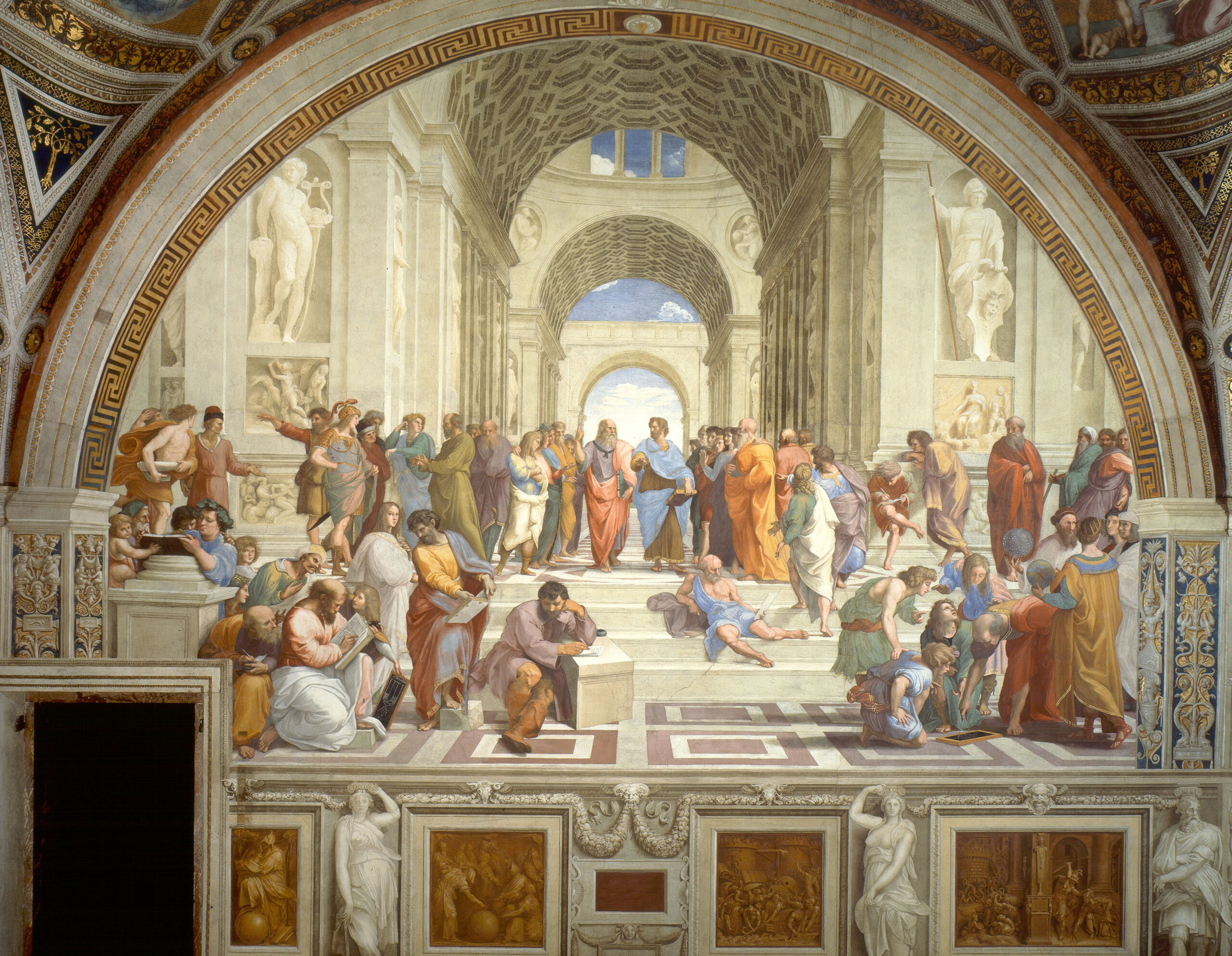
Raphael’s famous work School of Athens is a fresco, the painting taking up the entirety of a wall in what was Pope Julius II’s private apartment in the Vatican. Raphael was intending to demonstrate the power of the Roman Catholic Church through philosophy in a whole series of frescoes he created in the Vatican, of which the School of Athens is the most famous. If you look carefully in the center of this painting, you’ll see the famous Greek philosophers Plato and Aristotle. Plato, on the left, is pointing his finger upward, demonstrating his focus on “otherworldly” ideals like truth, beauty, and goodness. Aristotle, on the right, is pointing his finger out, reflecting his passion for the seen world (empiricism). The other men pictured also represent Greek philosophers. If you look closely, you can spot a man in a black beret, which is supposed to be Raphael himself (talk about just a little bit of ego!)
Notice how Raphael uses perspective in this painting, which focuses our eyes to the two men in the center.
Mediums…
Fresco: A painting technique in which paint is brushed onto wet plaster and let dry. Commonly used on buildings and ceilings (like the Sistine Chapel).
Tempura: A paint created from egg yolk ( or other water soluble binder) and pigment.
Oil: Became the most common type of Renaissance painting, allowing for much more intense colors and depth than tempura and fresco painting.
Art Project
Learn to draw using one-point perspective, similar to what Raphael used in The School of Athens.
Classical Music Piece
Listen to Renaissance composer Josquin Desprez while you work on your art!
Baroque 1600–1750 century
A Little Background…
The Reformation of the 16th and 17th centuries changed the landscape of Europe, breaking down the domination of the Roman Catholic Church. Since Reformation thinkers considered depictions of Christ idolatry, the Reformation was in general a movement away from traditional church art to simple worship and preaching. At the same time, the Roman Catholic Church sought to renew an interest in art to strengthen its hold on people. Powerful monarchs at the time, such as Louis XVI of France and his predecessors, also used commissioned art and architecture to demonstrate their absolute authority.
The Renaissance emphasized realism (portraying objects as realistically as possible), and the Baroque movement took that same emphasis and added more movement, drama, light, and energy with the goal of evoking senses and emotions.
Famous Artists from this period
- Caravaggio
- Annibale Caracci
- Rembrandt
- Lucas Cranach the Elder (Protestant Reformation artist)

Caravaggio’s The Calling of Saint Matthew uses an art method called tenebrism, which contrasts dark and light. Notice how the faces in the painting reflect a bright light, while the shadows and background are primarily dark. Also notice how much more realistic and active the figures are in this painting than the Maestà we looked at earlier, which is largely symbolic.
Medium/Styles
- Tenebrism
- Intense and warm colors
- Oil paint
- Sculpture
Art Project
For a detailed description of how to create your own tenebrism by creating white paintings using black canvas or paper, see here. For younger students, try using black construction paper and colored pencils to create your own tenebrism.
For an almost life-like “tour” of Baroque art and architecture, try looking up the Palace at Versailles on Google Earth. You can drop the little yellow guy into the building and tour many of the different rooms. Try to see if you can find Louis XVI’s bed!
Classical Music Piece
Bach is by far the most famous Baroque composer. Here are his Brandenburg Concertos. Listen carefully to hear the harpsichord in the background. Pianos had not yet been invented at this time, and harpsichords were their predecessors.
Romanticism 19th Century
A Little Background …
By the 18th and 19th centuries, there were so many artistic movements it is difficult to sum them up in one period. But in general, we can call Romanticism the prevailing thought of the day, and it greatly influenced art. Whereas, before this time, classicism in art emphasized order, harmony, and balance, Romanticism idealized art based on sensation and emotion. Artists became far more spontaneous and less realistic and orderly. Today, we’ll focus mainly on one movement within Romantic art: Impressionism.
Unlike the Baroque painting we just studied that was primarily dark, Impressionist painters liked to start with a white canvas and use color and energetic brush strokes. Instead of trying to paint an object realistically, they based their art on their initial feelings about the object. The focus was much more on the impression and expression of the artist than creating a realistic portrait.

Impressionist Painter Claude Monet created 250 paintings in his Water Lilies series. This one is called Nymphéas, which is just “water lilies” in French. They are huge, mural-sized paintings depicting his garden. Notice how instead of making the scene realistic, he uses large brush strokes to create a peaceful, calm feeling.
Famous Artists from this period
- Claude Monet
- William Blake
- Fransisco Goya
- Henry Fuseli
Medium/Styles
- Oil Paintings
- Pastels
- Drawings
Art Project
Make your own impressionist landscape painting!
Classical Music Piece
Beethoven is the most famous Romantic composer, but while we are doing our Romantic art project, we are going to listen to an equally talented, Romantic composer named Franz Schubert.
Modern Art (20th and 21st Centuries)
A Little Background…
There are many movements within modern and postmodern art that are very interesting to study! Because postmodernism rejects absolute truth, you’ll definitely notice that postmodern art tends to be very subjective and even random.
Expressionism is very similar in idea to impressionism, as the artist is not trying to realistically depict a scene, but rather convey his or her emotions about it. Expressionism often uses distortion or exaggeration to make a point. Vincent Van Gogh’s The Starry Night is a good example of this, although Van Gogh is technically considered a post-Impressionist painter, not modern.
Cubism focuses on flat, two-dimensional art and rejects many common art principles like perspective. It often appears to create a new reality with fragmented pieces.
Contemporary Art is very idiosyncratic, lacking structure, abstract, and often based on Freud’s idea that the subconscious is the most important part of the mind, which creates very spontaneous art.
Famous Artists from this period
- Jackson Pollock (Abstract Expressionist)
- Van Gogh (Expressionism, closer to the Romantic period)
- Pablo Picasso (Cubism)

Jackson Pollock, famous for his abstract Expressionism pieces, used household paint dripped across a canvas for this piece, called Number 8.[2]
Medium/Styles
There’s pretty much no right or wrong in postmodern art. Artists have used everything from dripping paint to bicycle wheels to create their art!
Art Project
Learn how to draw your own abstract art:
Classical Music Piece
The effects of postmodern ideas are definitely seen in classical music! Listen to Polish Postmodern Composer Zygmunt Krauze’s “Serenade.”
Hope you had fun learning about art history and creating your own art! Watch for more unit studies coming on the CHEC blog.
[1] Definitions based on the the New Oxford American Dictionary.
[2] By Jackson Pollock, https://www.wikiart.org/en/jackson-pollock/number-8-detail.

0 Comments