


by guest author Elena Maren
During the busy holiday season from Thanksgiving to New Year’s Day, your homeschool days may look different. Baking, traveling, church gatherings, and visiting with relatives can leave little room for your typical lesson plans.
 If that change of pace makes you wonder whether your children are still learning, take heart. Everyday family experiences throughout the holidays offer opportunities to practice skills, ask questions, and grow—even when the schoolbooks stay closed.
Practice Math Through Holiday Baking
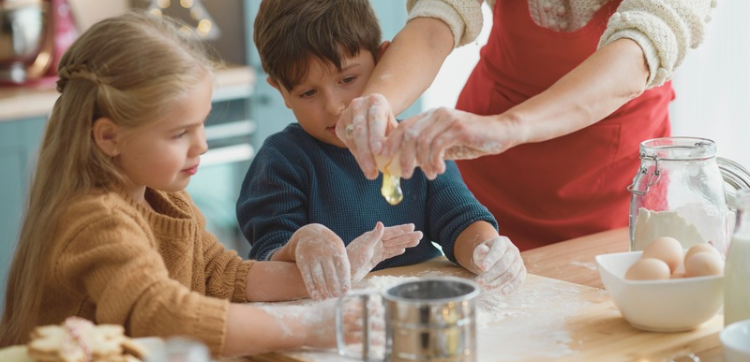
Measuring what goes into your family holiday treats (e.g., baked goods) uses multiple aspects of math such as measurement, portions, and comparisons. A 2016 study in Frontiers in Psychology linked numerical knowledge learned at home with stronger performance on early math tasks.[1]
When you’re making baked goods, younger kids can help by adding spoonfuls of flour; older kids can double recipes and guess how many cookies will be able to fit on a baking sheet. Beyond these everyday activities, early math skills can develop through play as children practice recognizing patterns, comparing quantities, and finding different ways to solve problems.
Build Language Skills Through Conversations & Reading
Holiday social gatherings give children opportunities to talk with friends and relatives they don’t interact with regularly. Instead of asking your child if they “had fun” at a social event, ask what surprised them in the conversation or what they might want to talk about next time.
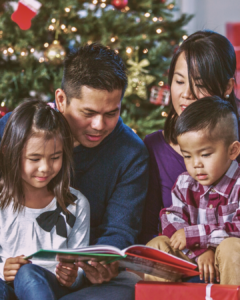
You can also continue working on language skills by reading together during the holiday season, and it’s not limited to reading holiday-themed stories. Recipes used for making holiday treats, greeting cards received, and directions for putting together a new toy/gift provide additional opportunities to introduce new words and talk about what they mean. The U.S. Department of Education’s guide[2] to foundational skills that support reading highlights that building language skills through conversation, storytelling, and shared reading experiences is important for developing reading skills.
Make Room for Learning Through Play
Learning experiences do not always have to be goal-driven. Building a fort, making crafts, making up games with one’s cousins, or going outdoors may require problem-solving, cooperation, and creativity after all. For instance, a walk in the winter may prompt questions related to animal footprints, changes that occur due to different seasons, or why deciduous trees lose their leaves every fall.
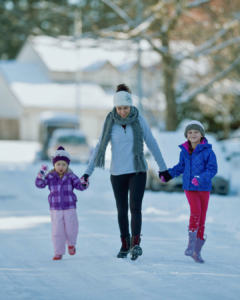 A 2019 study published in Frontiers in Psychology[3] suggests that experiences in nature can support attention, engagement, and learning. Although an afternoon spent playing outdoors can’t replace structured instruction, it does provide young learners with rich opportunities for exploration and discovery. At times, the most significant role a parent can assume is providing sufficient time for curiosity to grow.
Recognize Growth Without Making Everything a “Lesson”
One of the greatest challenges faced by homeschooling parents is determining when to encourage learning and when to allow children to simply enjoy an experience together. A child who takes initiative in measuring ingredients may demonstrate increasing self-confidence in their ability to understand numbers. Similarly, a child who patiently shares the rules of their favorite board game with a younger sibling demonstrates communication skills and possibly leadership skills.
On occasion, you might want to jot down a moment that shows how your child is growing and recall an event from previous years when revisiting those topics in future lessons. However, you don’t need to document every activity or convert your family traditions into learning exercises. As the holidays near, remember that growth isn’t always measured by completed assignments. Sometimes growth shows up in thoughtful questions, managing responsibilities independently, or solving a problem together around the dinner table.
What learning opportunities have you noticed in your family’s everyday holiday activities? Share your experiences in the comments below!
Research References
[1] Numerical Activities and Information Learned at Home Link to the Exact Numeracy Skills in 5–6-Year-Old Children. (2016). Frontiers in Psychology. https://www.frontiersin.org/journals/psychology/articles/10.3389/fpsyg.2016.00094/full
[2] Foorman, B., et al. (2016). Foundational Skills to Support Reading for Understanding in Kindergarten Through 3rd Grade. Institute of Education Sciences, U.S. Department of Education. https://ies.ed.gov/ncee/wwc/Docs/practiceguide/wwc_foundationalreading_040717.pdf
[3] Kuo, M., Barnes, M., & Jordan, C. (2019). Do Experiences With Nature Promote Learning? Converging Evidence of a Cause-and-Effect Relationship. Frontiers in Psychology. https://www.frontiersin.org/journals/psychology/articles/10.3389/fpsyg.2019.00305/full

0 Comments