



by Shari McMinn
Welcome to spring and Colorado outdoor living! Whether you live on the rural plains, in an urban area, or on a higher-elevation property in Colorado, you likely have a view of the incredible Rocky Mountains from your front (or back) door. What breathtaking vistas our views become even more so with sunrises and sunsets, amplified by the changing seasons we experience in this gloriously beautiful state!
For the Lord is a great God, and a great King above all gods. In His hand are the depths of the earth; the heights of the mountains are His also (Psalm 95:3-4).
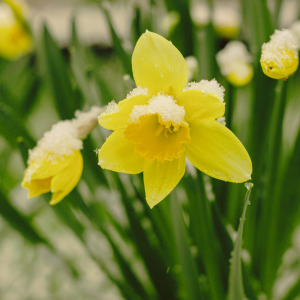
During early spring, with the first song of the meadowlark and the emergence of daffodils, our senses begin to come alive after winter’s indoor isolation. Often this time of year, our family would start the homeschool day with a walk up our half-mile remote driveway, singing as we breathed in the fresh air and sunshine we sorely missed during the all-too-long winter season. No longer bound by the constraints of bulky snow suits and layered warmth stiffening their agile bodies, my kids could run up and down the adjacent pasture hills, dodging prairie dog holes and blooming prickly cacti.
Why Take Your Homeschool Outdoors? 6 Stress-Relieving Benefits for Your Family
Oftentimes, homeschooling unique learners is stressful, with frequent strife and friction between the teaching parent and the student child. Therapy and other appointments dominate our time, with too much car travel. To get a break from all of that, positive time spent outdoors has many benefits. Keep things simple with these interactive strategies for developing your relationships and skills (shhh… don’t tell your students these actually count for homeschool hours!):
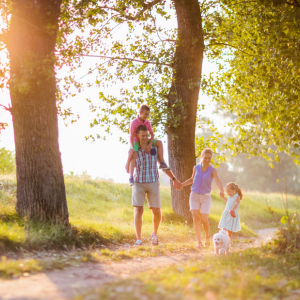 Allow for peaceful parent/student interaction: one-on-one or as a family unit; walking and talking, with silent interludes that allow for thoughtful contemplation.
- Build relationships while developing observational skills: with simple activities such as “I Spy” type guessing games.
- Take a complete break from technology: leave devices inside; enjoying the outdoors is relaxing for everyone because it doesn’t involve the brain processing required for reading or listening to audio lessons that may be part of your unique learners’ schoolwork.
- Make time each day to step outside together: often “quantity time” is more important than the quality of the time; making time each day, with no particular agenda in mind, reaffirms and strengthens relationships.
- Play simple movement games: activities such as tossing or kicking the ball develop gross motor skills and hand-eye coordination; failures such as overthrows and misses produce laughter!
- Relax the body, mind, and soul: walking with regular breathing, interspersed with deep breathing, regulates both adult and child, keeping at bay the reactive fear/flight/fight reflexes.
Four Additional Benefits for Unique Learners Who Homeschool Outdoors
If your child is old enough — mature enough — to spend time outside on his or her own, there are many benefits to having him or her play for long periods of time outside. Of course, it is important to supervise this, perhaps checking on them every 15 minutes after reinforcing ‘stranger danger’ safety tips.
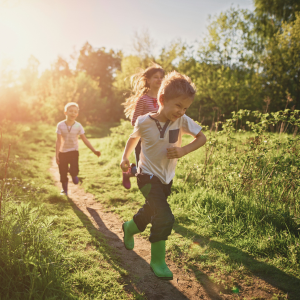 However, for every child, even those who are severely cognitively or physically delayed, spending time in God’s outdoor creation is developmentally important for these four reasons (and more):
- Improves eyesight: having to look closely, then look far away, develops the eye muscles and their connection to the brain.
- Teaches social skills: learning to be content as an individual playing alone develops imagination, self-confidence, self-governance, and time management.
- Develops personal knowledge and skills: curiosity, creativity, intelligence, observation, self-calming, self-reliance, and spatial awareness are gained.
- Strengthens physical ability: balance, breathing, gross motor coordination, hand-eye coordination, head/neck movement, and limb agility are developed.
Homeschool Outdoors: 7 Stress-Free Educational Activities
Did you know that one of the fastest growing areas of “special needs” therapy — albeit rather expensive therapy — is “Outdoor School”? Most children, including teens, are addicted to technology. They are not physically active enough to develop holistically as they should, so this type of “therapy” is now prescribed. But there is no need to leave home and pay for this type of therapeutic intervention! Instead, implement outdoor learning in your homeschool.
Live in an apartment or high-rise condo? No worries! You don’t need a farm to get outside and enjoy fresh air with these simple, multi-age activities:
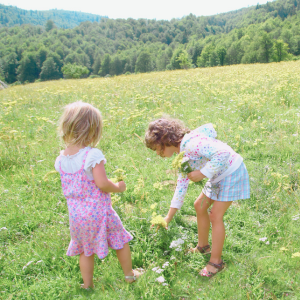
- Collecting found objects: gathering leaves, rocks, and flowers (on public walkways or private property with permission), then categorizing and sorting them into collections, teaches science and executive function skills.
- Dancing and singing: Broadway tunes, worship hymns, even your favorite folk songs will get minds and bodies coordinating with rhythmic dance movement; singing soothes the soul and develops deep breathing while improving speech diction and word formation, while memorizing lyrical poetry.
- Observing surroundings: discussing architecture, noticing community/neighborhood layouts, following maps, and noticing natural resource backdrops teaches civics, math, science, and stewardship of God’s creation, which enables the human imagination to develop and take dominion over the earth and even the universe.
- Physical exercising: alternating running, sprinting, and walking with biking, rollerblading, or scooter activity builds muscles and gross motor skill coordination.
- Sketching: plants, rocks, scenic horizons; drawing develops hand-eye coordination while your student looks up and then illustrates what he or she sees; keeping an art journal with notes will track location and date.
- Star-gazing at night: discussing ancient land and sea navigation based on the constellations, teaches astronomy, creation, history, military, science, and space exploration adventures, accomplishments, and careers.
- Studying the clouds: on both clear or stormy days, this encourages imagination while finding figures in cloud shapes, along with meteorology, and discussion of God’s “painted” sunrises and sunsets!
Dive Deeper: Additional Resources on Homeschooling Outdoors With Your Unique Learner
Want to learn more about this topic? Check out these articles and podcasts:
- Celebrate Kids podcast: “From Screens to Sunshine: The Importance of Outdoor Play for Children”
- ChurchLeaders.com article: “Beyond the Classroom: Outdoor Activities for Kids’ Spirituality”
- Focus on the Family article: “God’s Outdoor Classroom: Nature-Based Learning”
- Homeschool Broadcast podcast: “Outdoor Learning: The Brain-Boosting, Faith-Fueling Secret Weapon for Homeschool Families”
Find more support for you and your unique learner at CHEC’s Unique Learners webpage.
Be sure to register now for the Rocky Mountain Homeschool Conference. [NOTE: Bonus Day on Wednesday, June 10, is FREE and includes an afternoon Unique Learners Workshop Seminar (three sessions), with a meet-up following. The full conference also has a Unique Learner Workshop Track for further encouragement and practical help. SPECIAL OPPORTUNITY: A few Unique Learner Cognitive Assessments slots at the conference are still available, low-cost, and are provided by qualified evaluators.]
My next Unique Learner blog, “End-of-Year Evaluations for Unique Learners,” will be posted on May 20, 2026 (the 3rd Wednesday).
Shari McMinn, your trusted homeschooling friend
P.S. If you have a topic I should write about, please email me with your suggestion(s). This blog is for you!

0 Comments